Globally, more than two billion people suffer from hidden hunger, the deficiency of micronutrients or vitamins. Hidden hunger occurs as a result of consuming an energy-dense but nutrient-poor diet. It is often caused by a lack of diet diversity and over-reliance on staple cereal foods with low levels of micronutrients and vitamins. Among the micronutrients, deficiencies of iron, zinc, and selenium are most prevalent.
The previously discussed paradigm on responsible plant nutrition aims to tackle the hidden hunger problem through nutrient-sensitive farming. This includes more diverse crop rotations and biofortification of staple crops with micronutrients.
Rice – a dietary source for many
Rice is the staple food for over half of the global population, but its nutrient content is far from ideal. Especially polished white rice contains relatively low concentrations of essential micronutrients such as iron, zinc, and selenium.
At the same time, the plant tends to accumulate relatively high levels of toxic arsenic. Under anoxic conditions in submerged paddy soil, less iron oxides to bind arsenic are available. Hence, arsenic is released into the soil, reduced to the more soluble arsenite, which can then hitchhike on the uptake pathway for the nutrient silicon. The resulting rice plant contains fairly high levels of toxic arsenic.
Consuming rice accounts for about 60% of the total dietary intake of arsenic for the general population in China. That’s why optimizing the nutrient content of rice while limiting arsenic accumulation has become a crucial research goal.
Biofortifying rice crops
Recently, the lab of Fang-Jie Zhao at Nanjing Agricultural University, China, has found a way to biofortify multiple nutrients and simultaneously decrease arsenic levels in rice. Previously, they had isolated a rice mutant that tolerates higher levels of arsenic but accumulates less of it in the grain than wild-type rice cultivar.
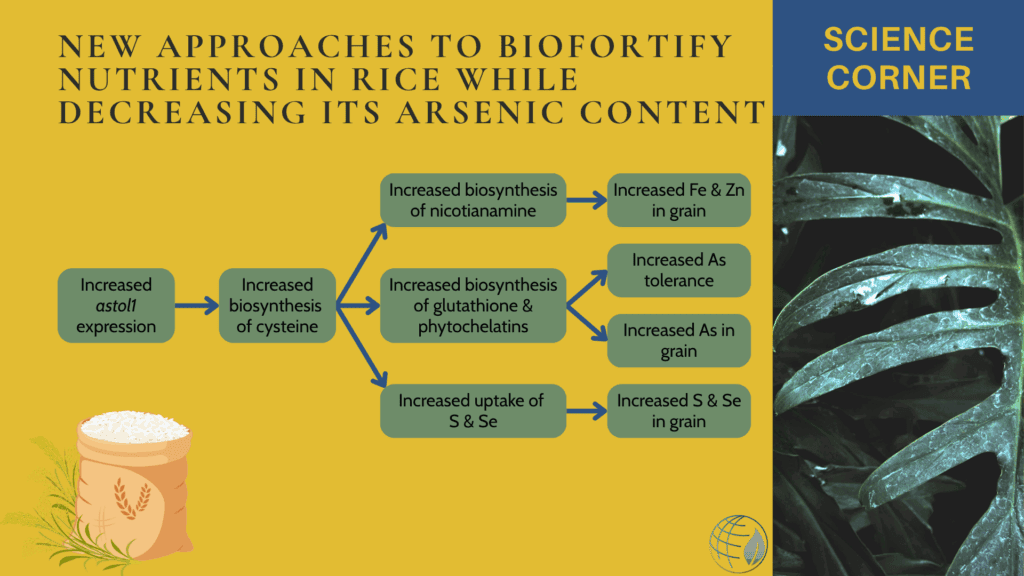
Through genetic and biochemical analyses, they identified a point mutation in a gene, called astol1, encoding a component of the cysteine synthase complex. The single amino acid substitution in the enzyme leads to an increased biosynthesis of cysteine. This sulfur-containing amino acid is essential for the biosynthesis of stress proteins and small peptides such as glutathione and phytochelatins.
With the goal of increasing the expression of astol1, they used a promoter sequence from a rice gene that is expressed at a moderately high level. They then conducted a series of hydroponic, soil pot, and field experiments to evaluate the performance of three independent lines of transgenic rice plants expressing the astol1 gene.
The transgenic rice showed normal growth and comparable grain yields to the wild-type cultivar. The biosyntheses of cysteine, glutathione, phytochelatins, and nicotianamine were increased significantly.
Transgenic rice crops with higher nutrient content
By biosynthesizing more phytochelatins, plants chelate and sequester more arsenic in the vacuoles in the roots and stems. This restricts its translocation to the grain. Hence, the transgenic rice became more tolerant to arsenic and accumulated up to 50% less arsenic in its grain.
At the same time, the enhanced cysteine biosynthesis allowed the transgenic rice to take up and assimilate more sulfur and its chemical analogue selenium. In total, this led to 67–80% higher sulfur and 37–170% higher selenium content in the rice grain.
Additionally, the transgenic rice accumulated 20–71% more zinc and 10–88% more iron in the grain. These levels are not surprising because an enhanced nicotianamine biosynthesis can promote the translocation of these micronutrients from roots and shoots to the grain. Other nutrients, including nitrogen, potassium, calcium, and magnesium, were also increased in the grain of the transgenic rice compared with the wild-type cultivar.
The take-home messages from these studies are twofold:
- Cysteine biosynthesis is crucial to biofortify the micronutrients zinc, iron, and selenium and to minimize arsenic accumulation in rice grain
- By expressing just one single mutant gene, crucial gene expression and metabolic networks can be tweaked to reach these optimal nutrient and toxin levels
Transgenic approaches to biofortify staple foods
These studies demonstrate the possibility of using transgenic approaches to improve the nutrient content and health attributes of rice. A similar approach may also be used for other major cereal crops.
Even though adopting these approaches ultimately depends on public acceptance, they are sustainable ways to improve available staple foods. Hence, transgenic approaches could become fundamental in tackling the global challenge of feeding our increasing world population.