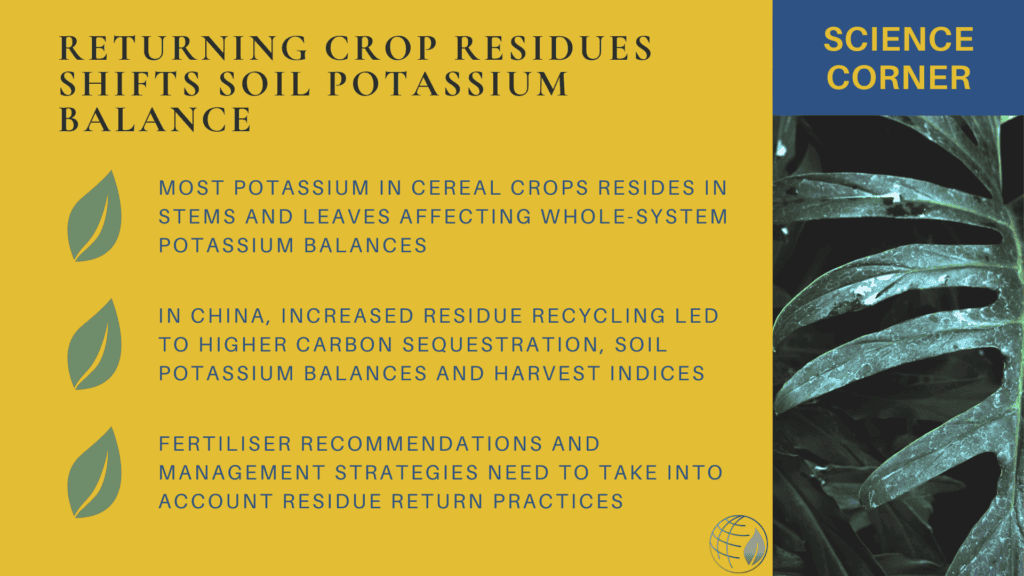
In cereal crops, about 70–80% of the potassium taken up by the plants is stored in stems and leaves. This means that only 20–30% is removed with the harvested grain. Consequently, how crop residue is managed impacts the overall potassium input–output balance in cereal-based cropping systems. Until now, this has rarely been quantified at larger scales.
In the study “Underestimated potassium supply from crop residue return in China’s major cereal systems”, the researchers quantified crop residue production and potassium recycling from crop residue for wheat, maize and rice in China.
They focused on the harvest index, which is the ratio of grain weight to total aboveground biomass. Their results suggest that the harvest indices of maize and rice have increased markedly over recent decades, whereas that of wheat has not.
In 2020, total residue production of maize, rice and wheat in China reached 620 million tons. During this time, residue potassium accumulation amounted to 10.7 million tons, which is 35% higher than previous estimates.
Returning crop residues to the field allows the remaining potassium to be released into the soil and subsequently taken up by plants. Increasing residue retention in the field provided a significant carbon sequestration benefit of nearly 50 Mt C annually. Similarly, residue potassium return almost doubled from 5.5 million tons in 2010 to 9.3 million tons in 2020. This influx outpaced the growth in mineral potassium fertiliser input (from 2.9 Mt to 4.5 Mt), shifting China’s cereal crop soil potassium balance from an annual −2.2 Mt deficit to a 1.2 Mt potassium surplus.
In summary, by returning cereal crop residues to the soil, more potassium is available for plant uptake. This change in management practices in China must be taken into account when adjusting fertiliser recommendations and management strategies. Similar studies should be conducted in other regions, especially where opposite trends of increased crop residue removal from the field were experienced.