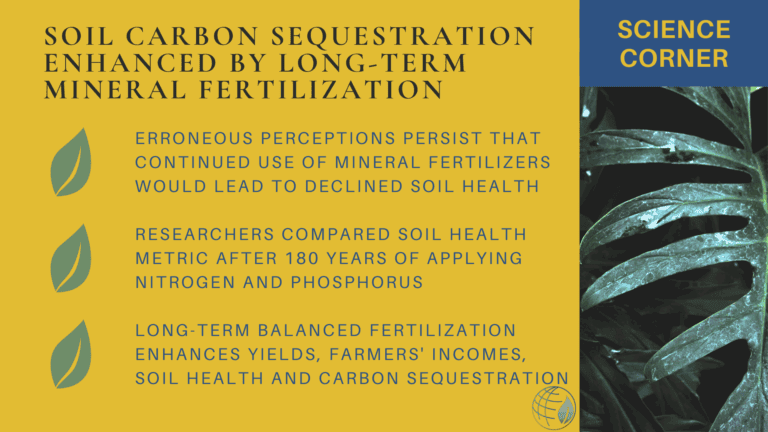
Inorganic fertilizers have sustained unprecedented growth in global food production for more than 100 years. However, one widespread myth persists: the long-term application of fertilizers might negatively affect soil health, including microbial diversity and function.
In this paper, a group of 14 researchers from different institutions combined standardized field surveys with a meta-analysis to assemble a global dataset of 501 long-term agricultural experiments, including data spanning more than five years, with a median duration of 25 years. Their aim was to evaluate the impacts of sustained fertilization on soil properties and microbial communities. As one of the first broad studies of this kind, it goes beyond more specific research conducted in individual experiments.
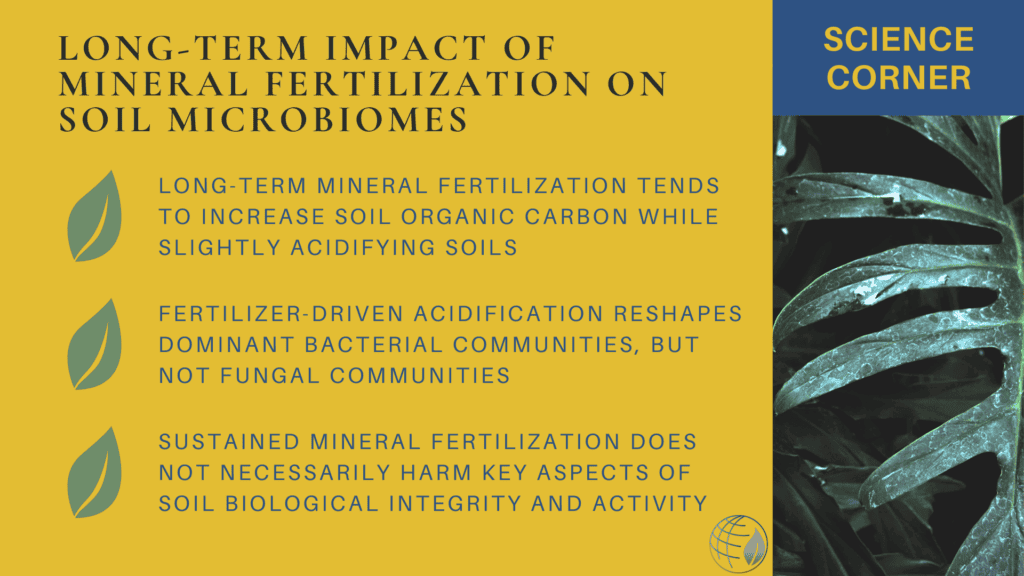
Not surprisingly, long-term mineral fertilization increased soil organic carbon by 14% and decreased soil pH by 0.3 units, on average, relative to unfertilized controls. Soil organic carbon accumulation largely explained increases in microbial biomass carbon and living bacterial biomass.
Fertilizer-induced acidification primarily reshaped dominant bacterial species, with the relative abundance of Proteobacteria increasing and Firmicutes declining. At the same time, the composition of the fungal community, including fungal pathogens, remained stable. Virulent bacteriophages increased in association with shifts in bacterial hosts. Microbial activities revealed a decoupling of nitrogen- and phosphorus-acquisition enzymes from the unchanged production of carbon-mineralization enzymes.
Overall, this global-scale analysis demonstrates that sustained mineral fertilization increases soil organic carbon and reshapes soil microbiomes in croplands in ways that are not necessarily detrimental to key aspects of soil biological integrity and activity. Care must be taken, however, to correct soil acidification through lime application where and when needed.