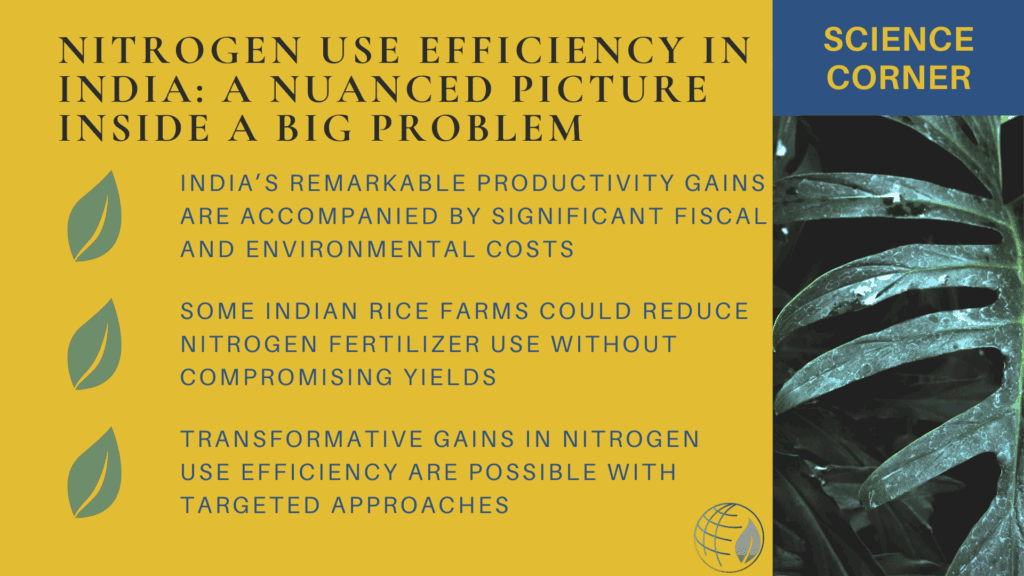
Since the 1960s, India has made remarkable strides in enhancing agricultural productivity to reduce food insecurity and rural poverty. From a position of dependence on global commodity markets, India now exports around 40% of the globally traded rice and routinely produces surpluses of other key staples, including wheat.
Success has been driven by a variety of factors: advances in crop genetics, expansion of low-cost irrigation, farm mechanization, and — perhaps most importantly — highly subsidized nitrogen fertilizer, primarily in the form of urea. As of August 2025, the Black Sea spot market price for a metric ton of urea is $496, or $2 per kilo. By contrast, the maximum retail price in India for urea is $2.78 for a 45-kilo bag – roughly $0.06 per kilo.
The difference between the price of domestically manufactured or imported urea and the subsidized price is borne by the Government of India. In the fiscal year 2025/2026, subsidy support is anticipated to cost more than $13 billion USD. Accordingly, fertilizer subsidies in India constitute around a quarter of all spending on agricultural development and food support programs.
Unsurprisingly, the Government of India is eager to reduce expenditure on urea subsidies in favor of other development and fiscal priorities. In 2019, a policy goal of reducing nitrogen use on a national scale by 25% was announced. This was followed in 2023 by the launch of the PM-PRANAM initiative that provides financial incentives to states to reduce subsidy expenditures.
Despite these goals together with supporting technical programs like the Soil Health Card initiative, excess nitrogen use at the national scale appears to have stabilized at a very high level for more than 20 years. As such, India remains a global hotspot for nitrogen pollution with both proximate impacts on environmental quality and global impacts on greenhouse gas emissions.
While the motivation to reduce nitrogen is clear, the strategies for doing so are less apparent. In 2017, the Cereal System Initiative for South Asia (CSISA) initiated a partnership with the Indian Council of Agricultural Research (ICAR) to close big data ‘gaps’. They deployed large-n production practice and crop yield surveys, so-called ‘Landscape Crop Assessment Surveys’ or LCAS, and surveyed more than 70,000 fields.
Initial analyses of these data revealed that the problem of nitrogen overuse is not universal. Some farms use too much nitrogen and could safely lower application rates. Others are nitrogen-limited and would incur significant yield penalties if policies to reduce urea subsidies were universally applied. In many cases, farms with the lowest yields appear to be generating the highest levels of nitrogen pollution.
Two recent papers relied on the LCAS data and applied machine learning and predictive modeling techniques to identify technical approaches and geographic priorities for improving nitrogen use efficiency (NUE) in rice. Results from the first analysis indicate that 55% of rice farmers could safely reduce nitrogen rates across the broader South Asia region, thereby improving NUE. Addressing yield constraints unrelated to fertilizer can also improve NUE, most promisingly through earlier transplanting and improving water management. Combining these approaches could reduce environmental pollution from nitrogen fertilizer by a third.
The second study identified nitrogen as a top limiting factor for rice yield in five of the six states assessed even though overuse is common among a sub-set of farmers in each state. In the eastern state of Bihar, predictive modeling suggests that an analytics-based nitrogen recommendation could increase annual rice production by > 500,000 t. However, to achieve this would require an additional 220,000 t fertilizer N.
In contrast, by jointly addressing nitrogen and irrigation co-limitations to yield, a similar production gain would be possible with a much lower investment in nitrogen. Only ~20% of farmers changing practices would lead to significantly higher yields (+0.4 to 1.0 t/ha) and profitability ($50 to 100/ha) among them. This approach would more than double NUE for new investments in nitrogen.
Together, these studies chart a targeted path for enhancing NUE through precision nitrogen management. It would combine rate reductions where they are sensible along with holistic approaches to responsible intensification. As such, large gains in yield and profitability would be achievable without jeopardizing NUE goals. Capitalizing on these insights will require closer coordination between policy, extension, and the scientific community in India along with appropriate incentives to support practice changes.
But could this be done while urea is priced at $0.06/kilo? A dose of realism is also required.