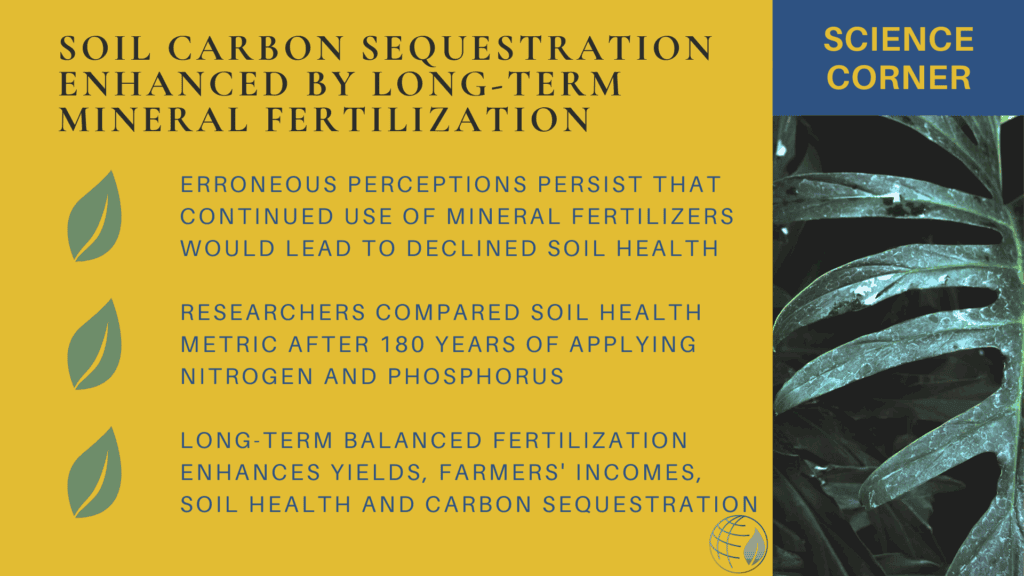
Soil organic matter is crucial for food security, soil health, climate mitigation and agroecosystem sustainability. Yet, there are still widely held perceptions that the continued use of mineral fertilizers might lead to a decline in soil organic carbon or soil health.
In a new landmark paper, a large group of international scientists analyzed that question in great detail. For this, they studied soil organic carbon and microbial health in the Broadbalk wheat experiment, the world’s oldest long-term experiment at Rothamsted Research, UK. They found that over 180 years, compared with no fertilization, long-term P, N and combined NP fertilization increased the soil organic carbon content by 10%, 22% and 28%, respectively, along with even larger increases in crop yield.
Phosphorus application alone disproportionately increased microbial respiration (37%) and biomass (20%), limiting stable soil carbon formation when no P was applied. Nitrogen application increased microbial carbon use and necromass accumulation efficiency, thus increasing mineral-associated carbon build-up. Combined NP fertilization enhanced plant-derived carbon inputs and the transformation of labile carbon into stable carbon, increasing soil organic carbon quantity and stability.
To confirm the Rothamsted findings, the authors conducted a global meta-analysis of numerous mineral fertilization experiments that included data on N fertilization and 96 studies that included data on P fertilization. On average, N and P fertilization globally increased cropland soil organic carbon by 21% and 13%, respectively.
The scientists summarized their findings in a conceptual diagram illustrating different magnitudes and mechanisms of SOC increase resulting from N and P fertilization. Clearly, long-term balanced mineral fertilization not only increases crop yields and farmers’ incomes, but also enhances soil health and soil carbon sequestration.