
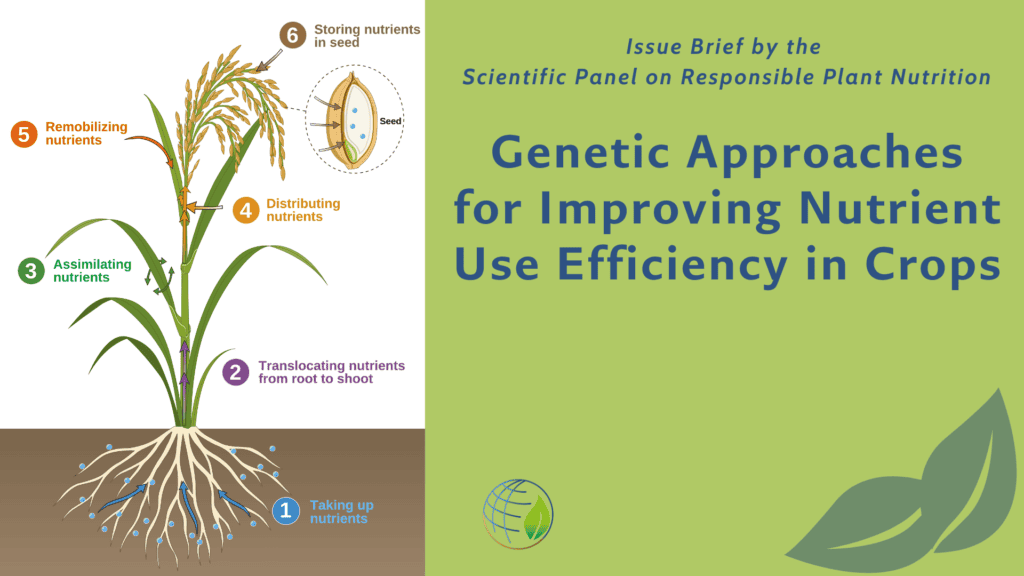
Every growing season, farmers apply fertilizer to feed their crops. And every season, much of it never makes it into the harvest. Rice, wheat, and maize typically take up only 40–60% of the nitrogen (N), 10–20% of the phosphorus (P), and 40–80% of the potassium (K) applied as fertilizer. The rest is lost to the environment, tied up in the soil, or simply unused.
As global food demand keeps rising, closing this gap has become one of agriculture’s most pressing challenges. This Issue Brief looks at one part of the solution: breeding crops that contain the genetic setup to potentially take up and use nutrients more efficiently.
Why nutrient use efficiency matters
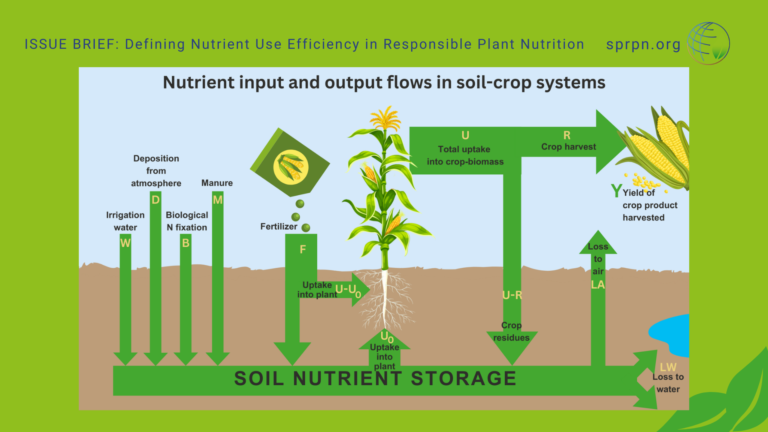
Fertilizer has been essential to feeding a growing world, but overuse comes with real costs: higher production expenses, nitrous oxide and ammonia emissions, nitrate leaching, and nutrient pollution of waterways. Getting more crop output per unit of nutrient applied is the foundation of nutrient use efficiency (NUE).
And improving NUE is central to producing more food without impacting the environment even further. Yet, no single intervention gets there alone: site-specific agronomic practices, better fertilizer technologies, and genetic improvement all need to work together.
For plant breeders, “nutrient use efficiency” isn’t one number; it’s several, each capturing a different part of the plant’s relationship with nutrients.
- Partial factor productivity (PFP) measures grain produced per unit of fertilizer applied
- Recovery efficiency (RE) measures how much of the applied nutrient the plant actually takes up.
- Internal efficiency (IE) measures how well the plant converts what it has taken up into yield.
- Nutrient harvest index (NHI) measures how much of that nutrient ends up in the harvested grain rather than in leaves and stems.
These four indicators give breeders concrete, measurable targets rather than a vague aspiration.
From gene discovery to the field
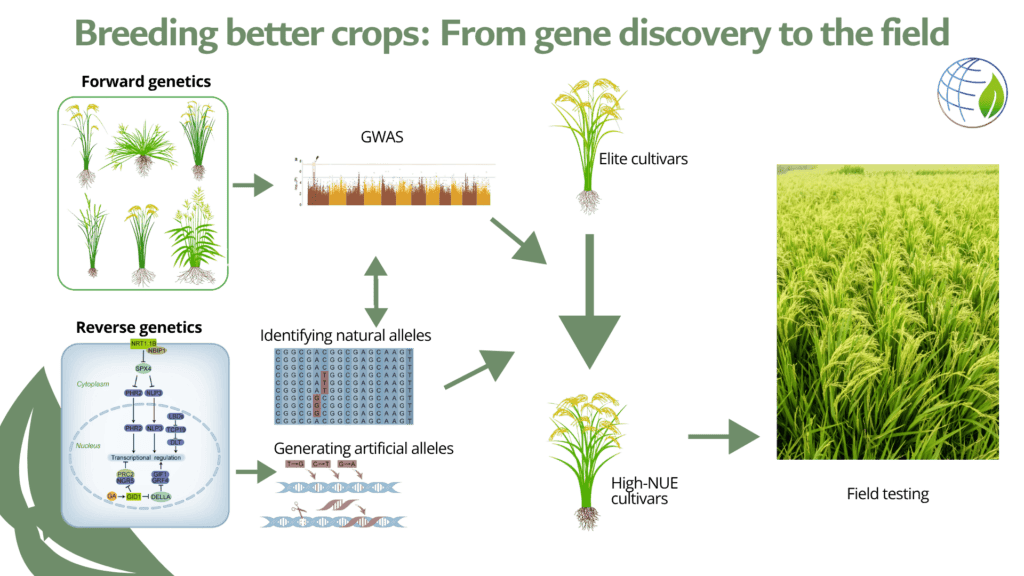
Breeding a more nutrient-efficient crop follows three broad steps, from research to application.
- Researchers screen genetic resources, such as gene banks, breeding lines, and wild relatives, to identify genes or alleles associated with better nutrient uptake or utilization
- They then introduce these genes into high-performing elite cultivars, either through marker-assisted selection or genetic engineering methods such as gene editing
- Candidate lines undergo rigorous, multi-season, multi-location field testing to confirm the gains hold up under real growing conditions
The brief highlights genes already characterized in rice, maize, and wheat that improve nitrogen, phosphorus, or potassium efficiency. It discusses case studies that focused on NRT1.1B, OsTCP19, OsGATA8, and OsNLP6 for nitrogen; PSTOL1 and SPDT for phosphorus; and OsNAC25 for potassium.
Not all of these are just laboratory findings though: OsTCP19 has already been bred into roughly 30 commercial hybrid rice cultivars in China, grown across several million hectares. Field trials showed 13–15% gains in nitrogen partial factor productivity.
Modeled scenarios suggest what more targeted breeding could achieve: even a 5–10% improvement in nutrient uptake or utilization efficiency in Asian rice production could save millions of tons of fertilizer nitrogen a year, without any loss in yield.
Improving nutrient use efficiency in practice
The brief highlights that the goal is not simply to apply less fertilizer. Feeding a growing population means total nutrient inputs will likely need to rise, not fall. The real prize is producing more grain per unit of nutrient applied; efficiency as a means of higher yields, not a route to using less fertilizer.
Increasing nutrient use efficiency based on genetic modifications have happened indirectly before: as a side effect of breeding for yield. The semi-dwarfing genes behind the Green Revolution raised harvest index and fertilizer responsiveness in wheat, rice, and barley. Maize breeding in North America lifted the nitrogen harvest index from 58% in 1946 to 69% in 2015.
Yet progress on dedicated NUE breeding has been slower than many researchers hoped. This issue is accompanied by a real risk in the field: many published claims about single-gene effects are based on limited pot-experiment or greenhouse data rather than robust field testing, with some even being overstated.
Turning promising genes into reliable, widely adopted varieties will require sustained collaboration between geneticists, physiologists, agronomists, and breeders — and a commitment to realistic, field-validated claims. While genetic improvement won’t solve the nutrient efficiency challenge on its own, it is a maturing, increasingly evidence-based part of the toolkit. Combined with smarter agronomy and better fertilizer technology, it offers a credible path toward crops that produce more food from every unit of nutrient we give them.

3 Responses
Mention of nitrogen harvest index in maize inadvertently via improved genetic medication for higher yield with higher harvest index is interesting and insightful. Indeed, improving phloem transport and dry matter partitioning for yield can improve nitrogen assimilation and remobilization, thus nitrogen harvest index and increased nitrogen use efficiency in crops. We have found that foliar spray of sulphydryl compounds like Thiourea can improve harvest index and grain yield of maize. Thiourea has also been found to increase nitrogen use efficiency in crops.
A good overview of efforts needed to improve NUE
Regards
Thank you for the kind feedback!